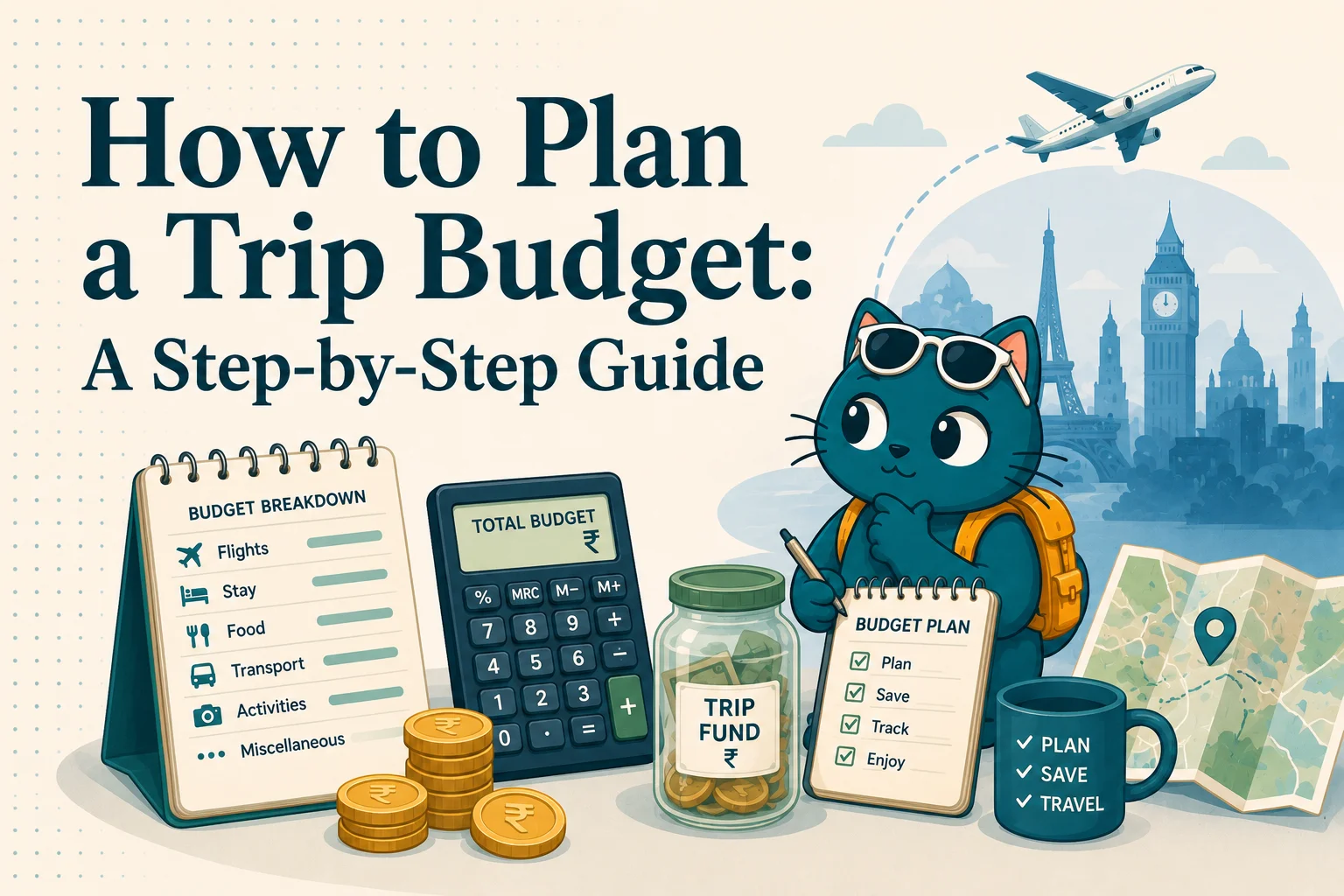
A good trip budget is not about spending less - it's about knowing where your money is going before it goes. Do it well and the whole trip feels calmer: no mental math at every meal, no nasty surprise on the card statement, no argument about who owes what. This guide walks through a simple, repeatable way to build a realistic travel budget, and how to keep it honest once you're actually on the road.
Start with the four big buckets
Almost every travel expense falls into one of four buckets. Estimate these first - they decide 80% of your total, so getting them roughly right matters far more than counting every coffee.
- Getting there: flights, trains, or fuel and tolls if you are driving. Usually the single largest line for international trips.
- Sleeping: hotels, hostels, or homestays, multiplied by the number of nights. Book one or two nights to anchor a realistic nightly rate.
- Getting around: local transport once you arrive - metros, autos, taxis, a rented scooter, intercity buses.
- Doing things: food, entry tickets, tours, and the small daily spends that quietly add up.
Write a number next to each bucket. It does not need to be perfect - a range you believe is worth more than a precise figure you invented.
Estimate a realistic daily spend
The two travel buckets - getting around and doing things - are best estimated per day rather than as one big lump. Pick a daily number that matches how you actually travel, then multiply by the number of days.
A quick way to set your daily number
- Add a typical day: breakfast, lunch, dinner, local transport, and one activity or ticket.
- Round up, not down - the day you underestimate is the day you overspend.
- Multiply by your number of days, then add one "splurge day" for a nice meal or a big experience.
Add a buffer (the step most people skip)
Every trip has costs you cannot foresee: a delayed train you have to rebook, a pharmacy run, a rain day spent in cafes, an ATM fee, a gift you did not plan to buy. Add a buffer of 10-15% on top of your total. If you do not touch it, that is money saved. If you do, you were well planned.
For international trips, fold two extra realities into your buffer: currency conversion (your card rarely gives the mid-market rate) and foreign-transaction fees. A budget built in your home currency but spent in another will drift unless you account for the gap. (Travelling abroad? Run our international travel documents checklist before you go, too.)
Split the budget into categories you can track
A single total is easy to blow through because you never see it moving. The fix is to break the total into categories - Stay, Food, Transport, Activities, Shopping, Miscellaneous - and give each a share of the whole. Now every expense has a home, and you can see at a glance which category is running hot while there is still time to adjust.
This is exactly what a trip planner does for you. In MyTripDude, each trip carries its own budget and categories, and every expense you log rolls up into a live budget-vs-actual view. You can even set a features overview to see how the pieces fit together.
Track as you go, not at the end
The best budget in the world fails if you only look at it when you get home. The habit that actually keeps you on track is tiny: log each expense the moment it happens - the taxi as you step out, the meal as the bill arrives. It takes ten seconds and removes all the guesswork later.
- Log the expense immediately, in the currency you paid in.
- Let the app convert to your home currency so totals stay comparable.
- Glance at the budget overview once a day - is anything running ahead of plan?
- Adjust the next day, not the whole trip. Small corrections beat a blowout.
Do this and the trip budget stops being a constraint and becomes what it should be: quiet confidence that you can enjoy the trip and still know exactly where you stand. For the on-the-road half of this, see how to track expenses while traveling abroad.
Frequently asked questions
How much should I budget for a trip?
Start with four buckets - transport to get there, accommodation per night, local transport, and a realistic daily spend for food and activities - then add a 10-15% buffer for the unexpected. The daily spend and the buffer are where most budgets go wrong, so estimate both generously.
What is a good buffer for a travel budget?
Around 10-15% of your total is a sensible buffer. It covers rebookings, medical or pharmacy costs, ATM and foreign-transaction fees, and unplanned buys. If you do not use it, it becomes a savings; if you do, you are prepared.
How do I track expenses in a different currency?
Log each expense in the currency you actually paid, and use a tool that converts to your home currency automatically so all your totals stay comparable. MyTripDude tracks expenses in any currency and rolls them into a single home-currency total per trip.
How do I stop overspending on a trip?
Split your total into categories, log every expense the moment it happens, and check each category once a day. Small daily corrections keep you on track far better than reviewing everything after the trip is over.